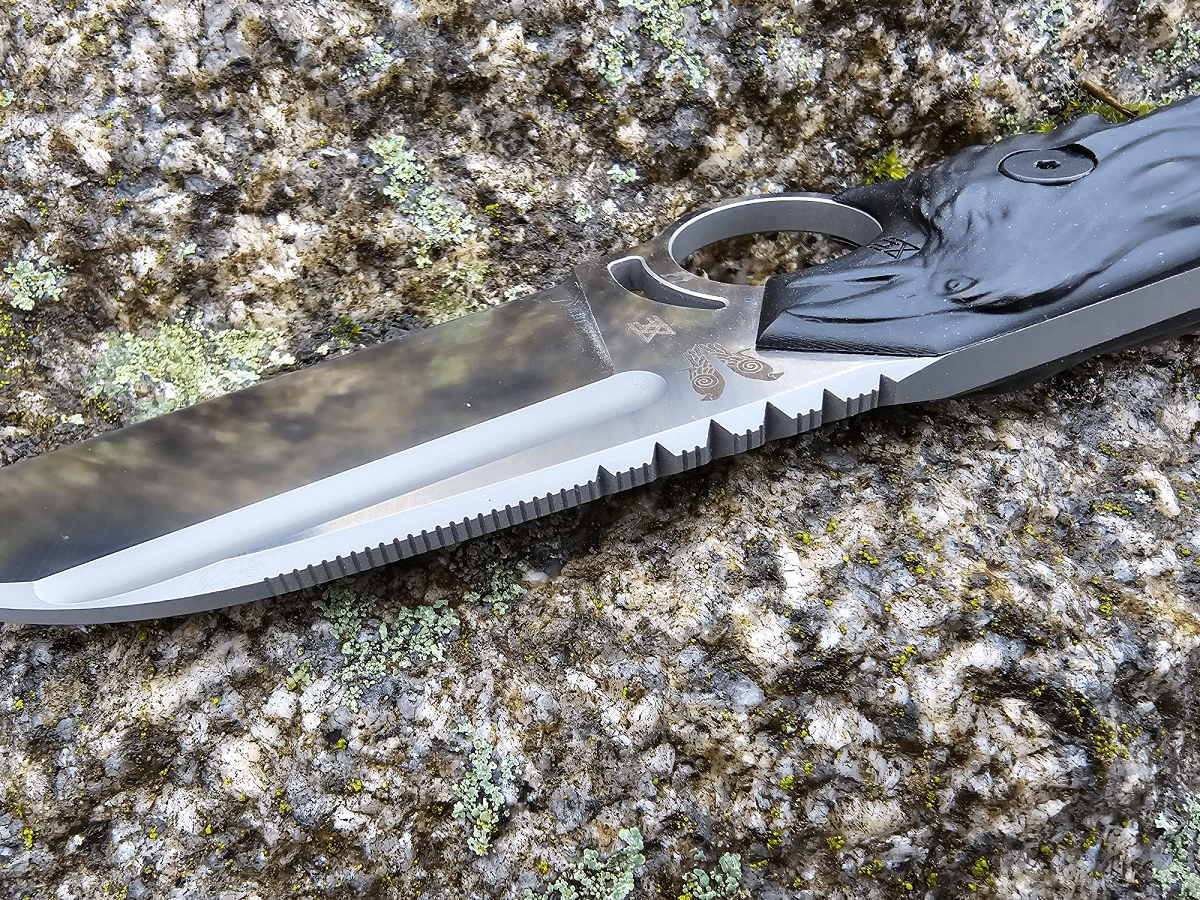
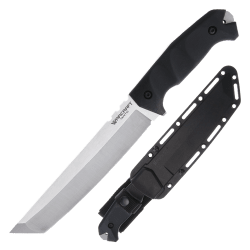
Midgards knife HuginV2 Raven handle scales elaborately milled from aircraft aluminum.
Etymology
Hugin (Icelandic: Huginn) belongs to the Old Norse verb huga "to think", the associated noun hugi "thought, meaning" is in turn the basis for the name Hugin.[1] Munin (Icelandic: Muninn) belongs to the Old Norse verb muna "to remember, to remember".[2]
Age and significance
If the depiction of the rider with two birds on the Vendel helmet plate and the depiction of rider figures in conjunction with one or more birds on Scandinavian gold bracteates show Odin with his ravens, the ravens would already be the god's companion or helper animals Migration period documented. In writing, Odin's connection with ravens is tangible in skaldic Kenningar of the 10th century. However, the names Hugin and Munin only appear in the tradition of the Songs Edda and the Snorra Edda.
Snorri Sturluson attributes to them a function consistent with the meaning of their name: “Two ravens sit on his [Odin's] shoulders and tell him everything they see and hear in his ear. Their names are Hugin and Munin. At daybreak he sends them out to fly all over the world, and at breakfast time they return. He learns a lot of news from them.”
The song Grímnismál says something similar:
Hugin and Munin have to fly over the earth every day.
I [Odin] fear that Hugin will not return home; But I care more about Munin.
 Member of EU
 0
0